
Why Taylors Never Became a City
Depending on how you count it, Taylors—were it to be a city—would be one of the larger ones in Greenville County. Except it never became one. This is one of the most frequent misunderstandings we encounter in our work, especially with people who are just moving here. They look at "Taylors, SC 29687" on their mail and assume there's a Taylors City Hall somewhere. The number of calls and emails we get looking for a Taylors building permit or asking how the City of Taylors handles trash has tempted me more than once to start collecting fees. Taylors, to a lot of people, feels like a place that should be a city.
To understand why Taylors never incorporated, we have to dig back into history a bit.
The Making of a Place
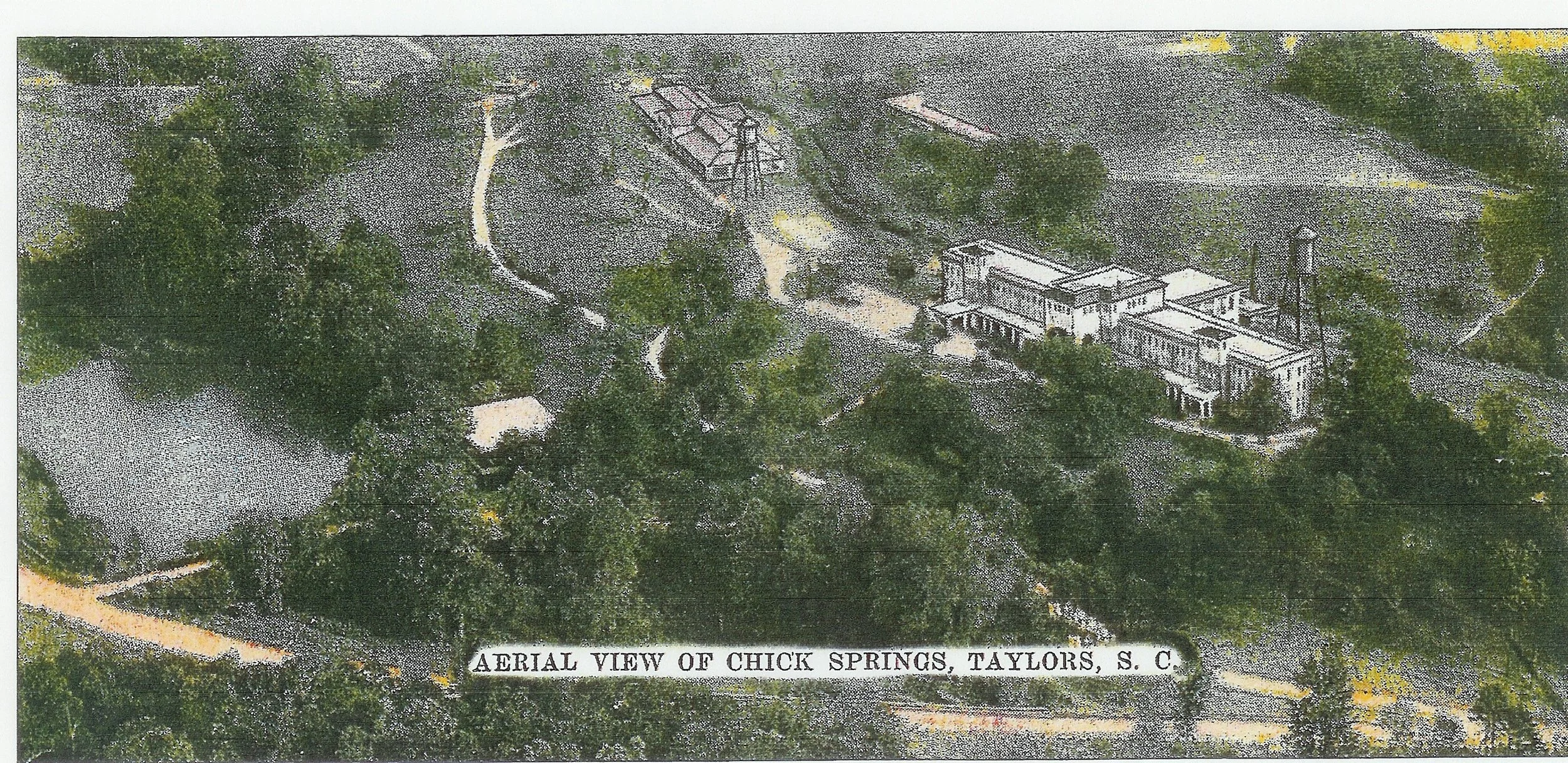
Taylors, as a named community, didn't exist until the early 1900s. Before that, the area's identity centered on Chick Springs—a mineral spring resort that drew visitors from the 1840s through the early twentieth century. The resort at one point included a hotel and 20 summer cottages, and water from Chick Springs was bottled and sold across the country.
But the coming of the Southern Railway changed everything. When a station was established on the property of Alfred Taylor around 1872 or 1873, it created a new center of gravity: "Taylor's Station." Over the years, the "Station" was dropped from the name, and the area became simply Taylors.
In the 1920s, a small downtown emerged near the intersection of what is now Taylors Road and Main Street. But that early economic development was largely wiped out by the Great Depression, and that part of the community never fully recovered.
The Mill Era
What did recover—and then some—was the Southern Bleachery textile mill. The mill shifted the focus of the community toward industrial employment, and for decades, the rhythm of life in Taylors was shaped by the mill's schedule and the families who worked there.
This matters for the incorporation question because mill towns often developed differently than other communities. The mill provided not just jobs but a kind of social infrastructure—housing, community spaces, a sense of shared identity—that in other places might have been provided by municipal government.
The Creation of the Fire and Sewer District
In 1958, the Taylors Water and Sewer District was established by Act No. 1099 of the South Carolina General Assembly. This was a critical moment. Rather than incorporating as a city to provide essential services, Taylors residents created a special purpose district—a government entity with a narrow focus on specific services rather than the broad authority of a municipality.
In 1966, the water distribution system was sold to the City of Greenville Waterworks System, and by 1968, the district had been renamed the Taylors Fire and Sewer District. This arrangement gave Taylors professional fire protection and sewer service without the overhead of a full municipal government.
Incorporation Attempts
Given all this, you might wonder: did anyone ever try to make Taylors a city? The answer is yes—at least twice.
The First Incorporation Attempt
The first significant push came in the 1960s, shortly after the fire and sewer district was established. But the effort never gained traction. Residents concluded they were already well served by the special purpose districts. Why add city taxes and another layer of government for services they were already getting?
Growth on Wade Hampton Boulevard
The second attempt came forty years later, driven by rapid commercial development along the Wade Hampton corridor.
In 2004, developers were building a $20 million shopping center called North Hampton Market on Wade Hampton Boulevard, anchored by Target and Hobby Lobby. The site was in the Taylors Fire and Sewer District, but the developers requested annexation into the City of Greer.
This was consistent with Greer's growth strategy. Since the early 1990s, the city had pursued what officials called "aggressive annexation," using infrastructure incentives from the city and the Greer Commission of Public Works to attract commercial development. From Greer's perspective, this approach was working—creating jobs, building tax base, and keeping "local dollars local," as City Administrator Ed Driggers put it at the time.
From the Taylors Fire and Sewer District's perspective, it meant watching commercial tax base leave the district. The district objected to the annexation, but as a special purpose district rather than a municipality, Taylors simply couldn't offer comparable incentives. The North Hampton Market was annexed into Greer.
By April 2005, another $60 million in development was heading the same direction. The Greenville News reported that even the Fuddruckers franchisee opening on the corridor that summer expected his Taylors location would eventually become part of Greer.
The 2005 Referendum
Some Taylors residents saw incorporation as the answer. Bill Wilson headed an incorporation committee that got to work in August 2004. They gathered petitions, filed with the South Carolina Secretary of State, and commissioned a feasibility study. By summer 2005, they had secured approval to hold a referendum.
The vote was set for July 19, 2005. If it passed, Taylors—with roughly 25,000 residents—would become the second-largest city in Greenville County.
Bryan Altier, the commission's spokesman, framed incorporation as a way to preserve Taylors' identity and give residents a voice in their own governance. The proposed boundaries would follow the Taylors Fire and Sewer District's 16 square miles. The initial budget was $644,000, with most revenue coming from state-shared funds. Council positions would be unpaid for the first two years.
Dan Hamilton, then a 29-year-old partner with Keller Williams Realty, filed to run for mayor unopposed. (Hamilton would later serve in the South Carolina House of Representatives and, in 2016, came within a few points of making the runoff in the Republican primary for South Carolina's 4th Congressional District.)
But incorporation had vocal opponents as well. Critics argued that Greer wasn't interested in annexing residential areas and pointed out that South Carolina law requires 75% of property owners to petition for annexation—a high bar that protected homeowners from involuntary annexation. They worried that a new city government would inevitably mean higher taxes, and questioned whether the incorporation committee had provided enough specifics about what services the city would provide and at what cost.
Greer Mayor Rick Danner weighed in with an op-ed in the Greenville News arguing against Taylors incorporation. The piece struck a nerve with some residents—one voter told the paper afterward that Danner's public opposition was precisely why he voted yes: "The fact that the mayor of Greer does an article in The Greenville News saying that Taylors was a bad idea gives me all the more reason why it's a good idea."
The commission held public meetings every Monday at the Taylors library in the weeks leading up to the vote. Residents on both sides packed the room—sometimes as many as 80 or 100 people—asking pointed questions about budgets, police protection, and tax implications. The debates could get heated. When asked directly whether taxes would increase, Altier said that based on the current level of services, no, but he acknowledged that a mayor and city council would have the legal authority to levy taxes. "They could come in and levy taxes," he said. "I'm just being honest with you."
On July 19, 2005, about 25 percent of eligible voters went to the polls.
No: 2,356 (63%) Yes: 1,403 (37%)
The incorporation effort failed by almost two to one.
Making Sense of the Results
The reasons people voted the way they did were complex.
Some no voters feared tax increases and were satisfied with the county's existing services. Some didn't trust the proposal's lack of specifics. "They are still keeping people in the dark," one resident said. "That scares me." Some simply didn't believe annexation posed a threat to their homes.
Some yes voters wanted local control and a stronger community identity. Some were genuinely concerned about commercial erosion. Some, like longtime resident Charles Gentry, just wanted to formalize what already felt true: "It's just a good place to be. I want it to be a city, so nothing changes."
Dr. Thomas Bowman, a local pastor who served on the incorporation commission, tried to find meaning in the process regardless of the outcome. It helped people "take a deep look at ownership of one's citizenship in the area where one resides," he said. It brought awareness of "what can take place in the life of a community when its citizens start to think about what's going on."
Why This History Matters
I share all this not to relitigate a twenty-year-old vote, but because I think understanding this history helps make sense of Taylors today.
It explains why we have a strong sense of place without the formal structures that usually come with it. It explains why the Target on Wade Hampton has a Taylors address but a Greer name. It explains why, when you need a building permit, you call Greenville County.
And it's a useful reminder that the question of what it means to be a community—and how we organize ourselves to take care of each other—isn't new here. People have been asking it for a long time. As Taylors TownSquare, we've chosen different ways to pursue answers to this question over the years. We're excited to keep at it in 2026 and beyond.
Archived reporting from the Greenville News was instrumental to this piece:
"Greer development makes Taylors nervous," Amanda Ridley, The Greenville News, April 27, 2005
"Boundary issues give some in Taylors an edge," Nan Lundeen, The Greenville News, June 9, 2005
"Bottom line at Taylors incorporation hearing: taxes," Nan Lundeen, The Greenville News, June 14, 2005
"Taylors prepares to vote to forge its identity," Ishmael Tate, The Greenville News, June 15, 2005
"Vote may reshape Eastside's future," Nan Lundeen, The Greenville News, July 17, 2005
"Taylors' fate now rests in voters' hands," Nan Lundeen, The Greenville News, July 19, 2005
"Taylors residents reject incorporation," Nan Lundeen, The Greenville News, July 20, 2005