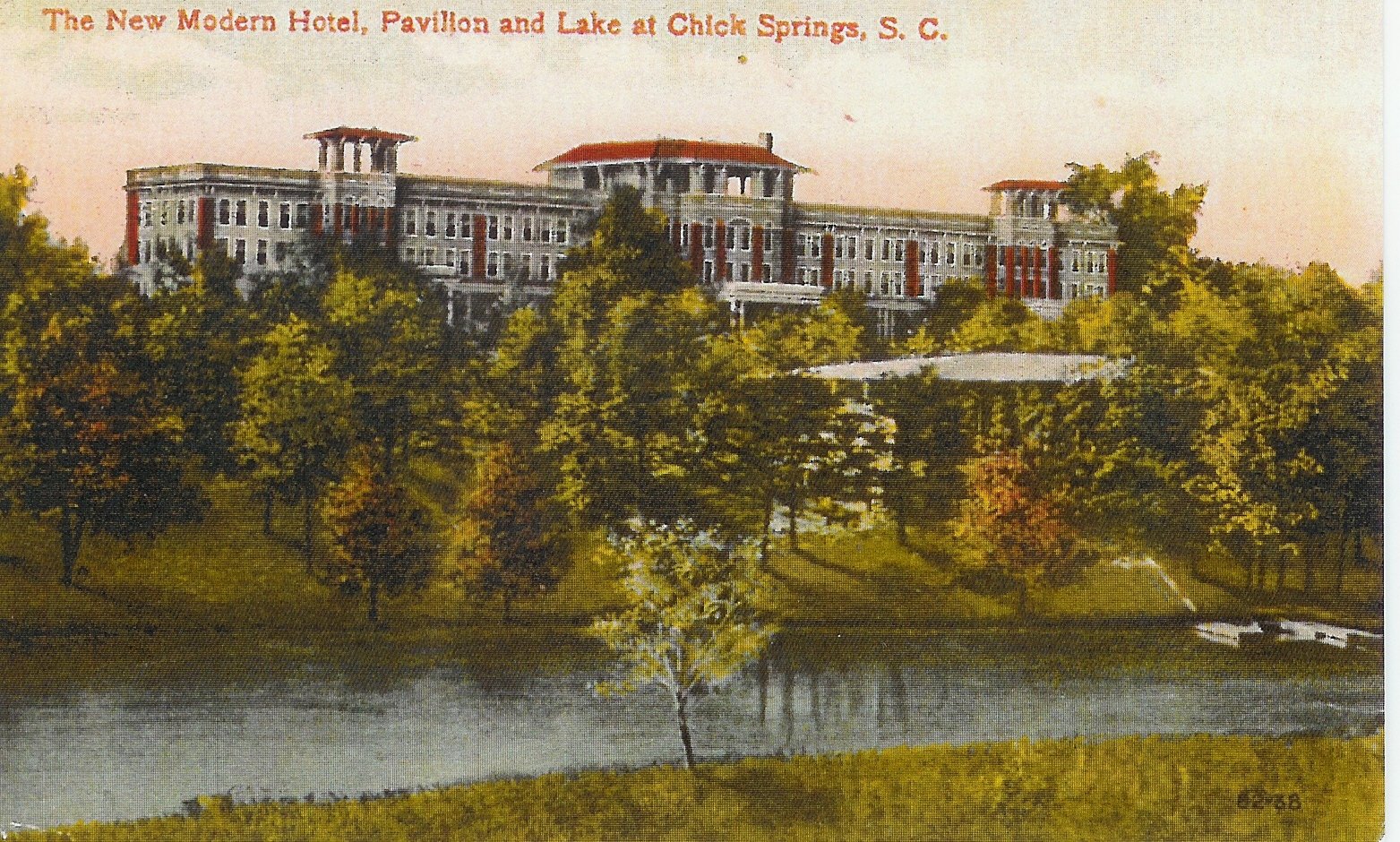
Chick Springs
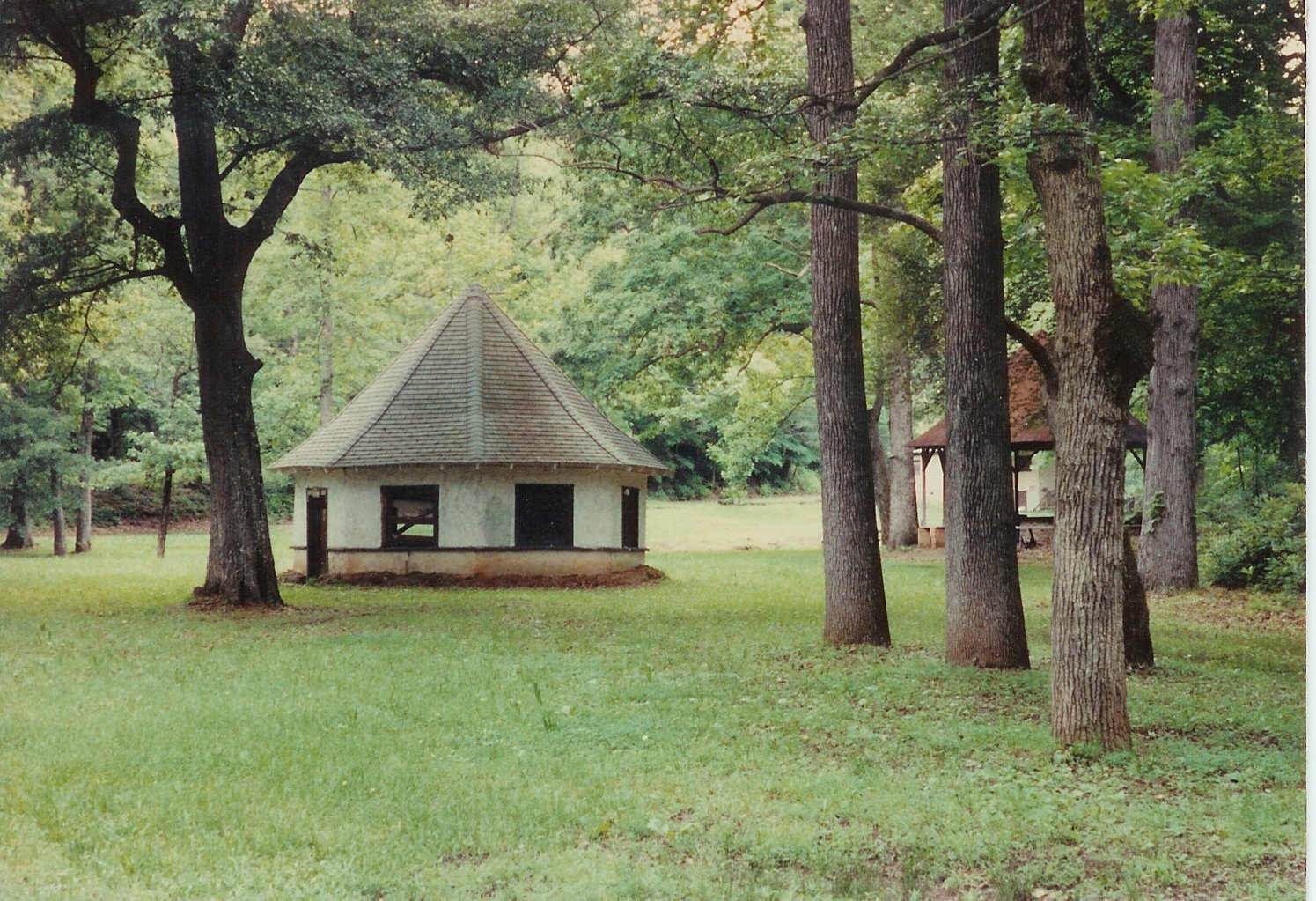
The historic Chick Springs property in Taylors has had major significance to the upstate for hundreds of years. Taylors TownSquare is championing a project to turn it into a park and potential future trailhead for the Enoree River Trail system. Taylors TownSquare has a unique opportunity to acquire the property that includes the original springhouse and gazebo and transform it into a publicly accessible place.
You’ve seen the name Chick Springs...
but what is it?
Learn about the history and significance of Chick Springs during a community gathering that takes a closer look at why this place matters to Taylors—and why it’s worth preserving.
Join us March 26 at 6 pm at Taylors Ministry Center (1 E Main St, Taylors; beside Taylors Coin Laundry)
Free event; registration is requested.
The History of Chick Springs
Chick Springs, nestled in what is now Taylors, South Carolina, has long been a place of gathering, healing, and hospitality. Before European settlement, the Cherokee people knew the mineral spring as "Lick Spring"—a place where deer gathered to lick the mineral-rich rocks surrounding the cool, clear water that bubbled up from the earth.
The spring was documented by Governor John Drayton in 1802 and by Robert Mills in his 1826 Statistics of South Carolina well before Dr. Burwell Chick, a Virginia-born physician, arrived in 1838. Guided to the spring by local Indians, Chick spent two years assembling the land around it and by 1840 had opened one of the Upstate's first destination resorts. Within two years, a sixty-room hotel offered board at a dollar a day, and a newspaper reporter would soon call it "this Saratoga of Greenville"—a place where Louisiana cotton planters mingled with local farmers on the piazzas, with pianos, dances until midnight, and a Catholic priest whose summer masses were the first held in Greenville County.
By the late 19th century, the railroad's arrival transformed access to the area. Visitors came from Charleston, Richmond, and New Orleans. But the railroad also began pulling the community's center of gravity away from the spring. Over three decades, the road was rerouted, the schoolhouse was physically moved, the church voted to relocate, and the post office was renamed. By 1904, "Chick Springs" had become "Taylors"—the spring that organized a community yielding to the railroad stop that bore hotel manager Alfred Taylor's family name.
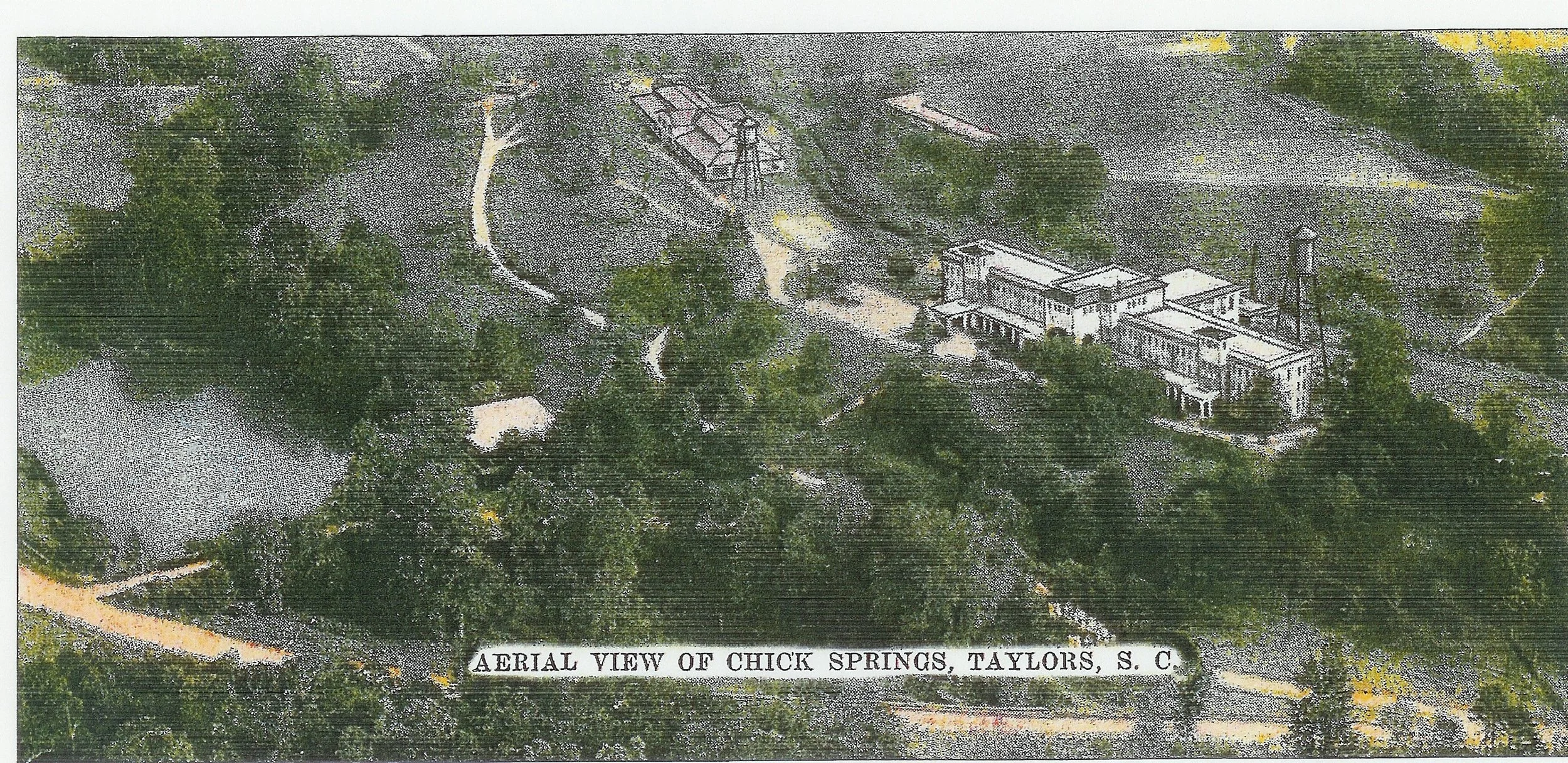
The spring kept drawing people. J.A. Bull, a Greenville grocer, purchased the property in 1903 and expanded the hotel from sixteen rooms to 119. By 1904, the resort was taking out full-page ads in the Atlanta Journal, marketing across the Southeast. Four thousand guests registered in a single season, arriving on six daily trains. Fire destroyed the E-shaped hotel in December 1907. A new one went up by 1914, and after a brief run as a military academy during World War I, Dr. Ben Steedly converted it into a clinic and sanitarium—a $250,000 corporation with a nursing school and patients from across the state. When he died suddenly of a cerebral hemorrhage in January 1932, the clinic went into receivership within weeks.
Then the state built Highway 29 through the property in 1925. An inadequate culvert turned the road embankment into a dam, and in September 1929, flooding submerged the site in twenty feet of water. The company won a landmark South Carolina Supreme Court case, but the damage—arriving alongside Steedly's death and the Depression—was irreversible.
What followed wasn't a quiet disappearance. A Spartanburg car dealer acquired the hotel at a federal foreclosure auction in 1937. By late 1938, it was being rented as apartments. By early 1939, its boilers were being sold off at "give-away price." In March 1940, the Greenville News photographed the building being torn down for a real estate subdivision. The most significant building in the area, and a single newspaper photo marks its end.
But one thing outlasted everything. Bull had built a swimming pool fed by Lick Creek in 1926, and for nearly fifty years it kept the Chick Springs name alive. Through the 1930s, it drew crowds for Red Cross swim lessons and water shows. From the 1950s through 1972, it was the place to be for a generation of Taylors High School students—with a tin slide, a high dive, a jukebox, and a shag dance floor. It closed in late 1970s, and public access ended.
For the next two decades, a network of local historians and conservationists fought to bring the property back. That effort spanned nearly twenty years before Taylors TownSquare acquired the core 8.62-acre spring site in July 2024. Months later, Hurricane Helene destroyed the historic springhouse. Restoration is now underway.
Chick Springs is the place that made Taylors. For two hundred years, people have gathered here to take the waters, to swim, to dance, to heal. Many know the name. Few know the story. We're working to change that.
Greenville County Council Member Mike Barnes (left), Taylors TownSquare President Alex Reynolds (center), and For 8 Corporation Project Manger Lily Niemela (right) at the Chick Springs site after the title signing on May 29, 2024.
Taylor TownSquare acquired the 8.62 acres shown on this plat, including the historic spring house at Chick Springs.
Taylors TownSquare commissioned Preservation South to complete an existing conditions report for the Chick Springs historic structures, completed in Q2 2025.
Updates about Chick Springs
The Present and Future
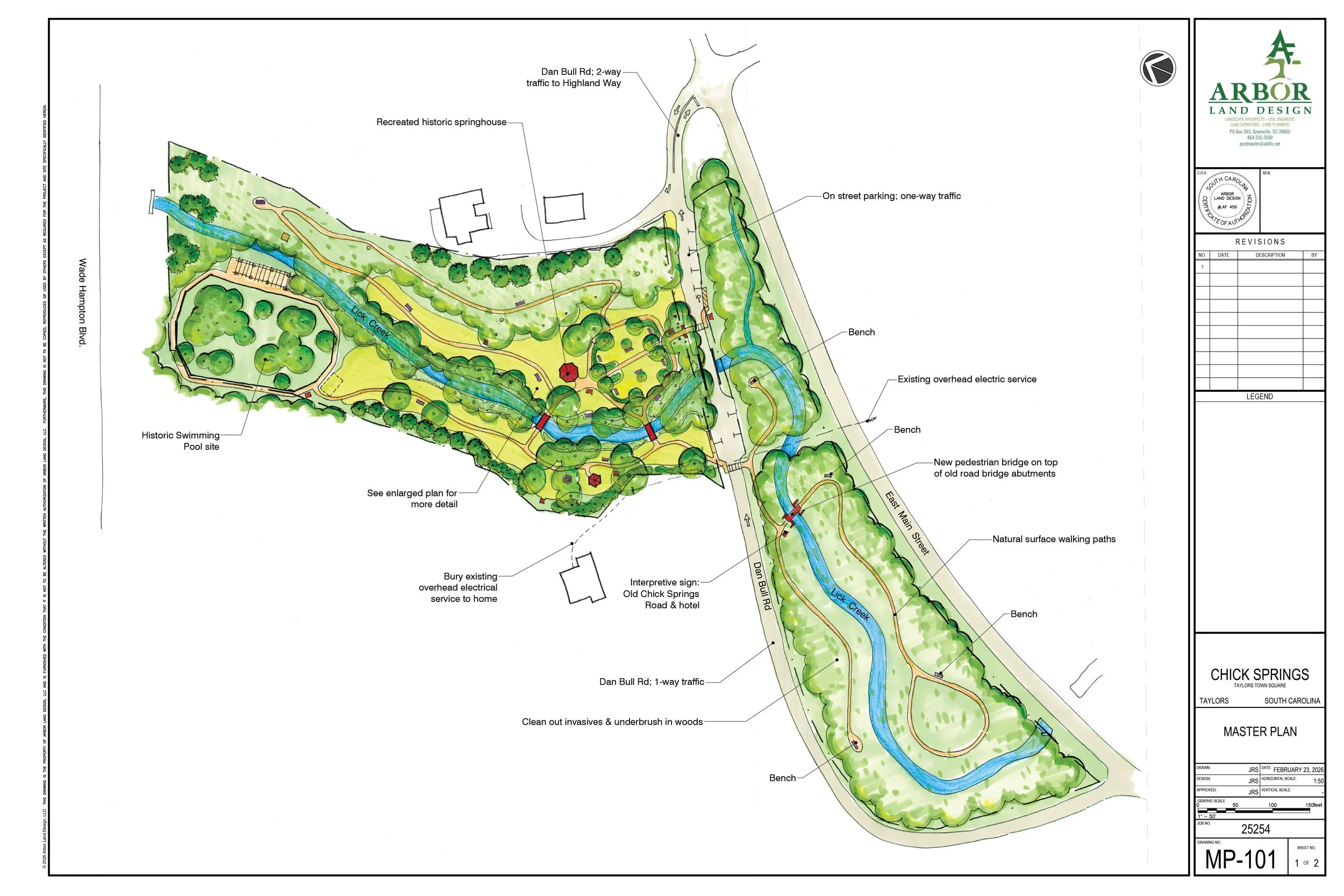
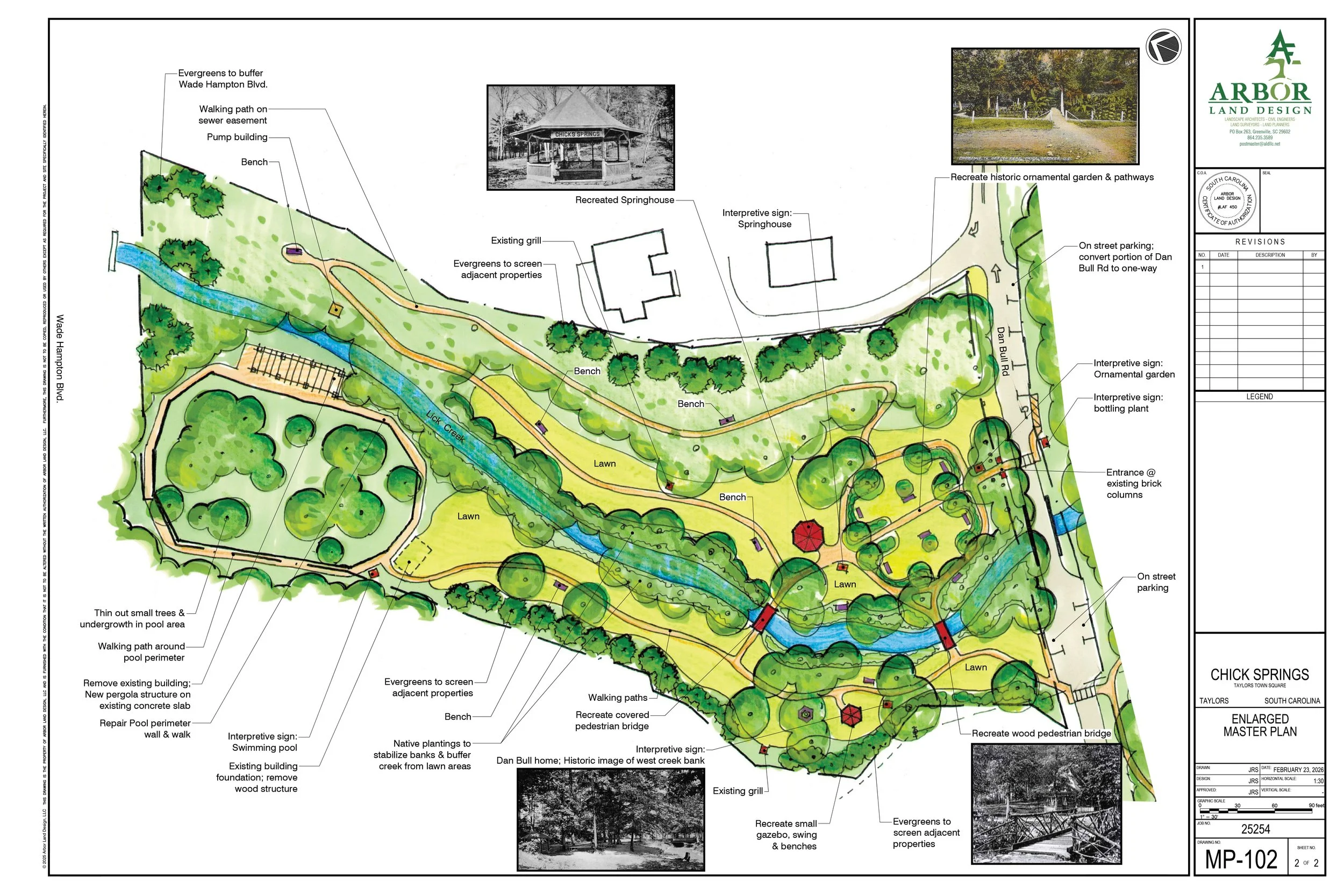
Taylors TownSquare has taken the lead in bringing a public park at Chick Springs to fruition. Working with the founding members of the former Chick Springs Historical Society and other community members, we are actively working to preserve and open up the property so that all the public can learn about and enjoy this historic location in the upstate.
The next steps include:
Developing a master plan for usage and safety
Working towards linkage with a potential Enoree River Trailway
Implementing the plans and creating a park
How You Can Help
Recurring and one-time contributions to our Chick Springs Fund directly support our work to restore the Chick Springs site.
Recurring contributions give us the flexibility we need to respond to situations as they arise.
Your contributions will assist with the following:
Creation of necessary plans for restoration work.
Restoring and rebuilding historical structures
Maintaining the grounds
Adding signage to explain the history
Finishing the parking area
Potentially rebuilding the bridge over Lick Creek
Subscribing to Taylors TownSquare emails here will also add you to the list to be notified about upcoming happenings involving Chick Springs. Make sure to select Chick Springs.